

Slot Mechanics Explained: RTP, Volatility, Hit Frequency, and Why Your Slot Choice Probably Sucks
Most people pick slots the way they pick Netflix shows. Cool thumbnail. Interesting name for a slot machine with unique symbols on the reels. Maybe someone on Reddit mentioned it in relation to free spins. Spin a few times. Get bored. Pick another one.
Nobody checks the RTP. Nobody looks at the volatility rating. Nobody has any idea what hit frequency means. And then they wonder why they lost £200 in forty minutes on a slot that was mathematically designed to eat money faster than a toddler eats crisps.
I’m not judging. I did the same thing for years (I sometimes do this shit still..) Picked slots based on whether the theme looked good, completely ignoring the three numbers that actually determine how the game behaves with my money. It’s like choosing a car based on the paint colour and not checking whether it has an engine.
This is the article I wish someone had forced me to read before I ever pressed spin. What slot return to player actually means, what volatility does to your bankroll, what hit frequency tells you that RTP doesn’t, and which slots are genuinely worth your time if you care about the numbers.

What is RTP? (And Why 2% Means A lot)
RTP stands for Return to Player. It’s the percentage of all wagered money that a slot is programmed to pay back over its lifetime. A slot with 96% RTP theoretically returns £96 for every £100 wagered. The casino keeps £4. That £4 is not a mistake. That’s their business model – they’re out to get us lads.
Simple enough. But here’s where most people’s understanding stops, and it’s where the important stuff actually starts.
First thing. RTP is calculated over millions of spins. Not your session. Not your weekend. Millions. In the short term, anything can happen. You can win £500 on a 90% RTP slot or lose £500 on a 99% slot. RTP tells you about the long game. It tells you absolutely nothing about what’s going to happen in the next twenty minutes.
Second thing. A 2% RTP difference is massive when considering the odds of winning. Most people see 94% vs 96% and think “that’s basically the same.” It’s not. On a 94% RTP slot, the house edge is 6%. On a 96% slot, it’s 4%. That means the 94% slot takes 50% more of your money per spin than the 96% slot. Over £10,000 of play, that’s £600 lost versus £400 lost. Two hundred quid difference from two percentage points that “looked basically the same.”
Third thing – and this is the one that should genuinely make you angry. The same slot can run at different RTPs at different casinos. A provider might offer a game at 96.5%, 94.5%, or even 92%. The casino chooses which version to run. Most don’t tell you which one you’re playing. The game looks identical. The name is identical. The theme, the sounds, the bonus features – all identical. But one version returns £96.50 per £100 and another returns £92. That’s a 48% increase in house edge and the only way to know is to check the game info screen before you play.
Some bonus buy features also change the RTP depending on whether you buy or spin naturally. We wrote a full breakdown of how bonus buy features affect RTP and the odds of winning. if you want the details on how slot machines work. Short version: some slots give you better RTP when you buy, some give you worse. Check the game mechanics before you click.
The Highest RTP Slots (That Are Actually Worth Playing)
Since everyone searches for the best RTP slots, here are the ones with the highest verified return to player percentages. These are the slots where the maths is least hostile to your wallet.
99%+ RTP – the unicorns: Mega Joker (NetEnt) sits at 99% in Supermeter mode. Book of 99 (Relax Gaming) hits 99%. Ryse of the Mighty Gods (OneTouch) claims 99.1%. These exist but they come with caveats – Mega Joker requires you to play max bet to access the 99% mode, and the volatility is high enough that you’ll need a substantial bankroll to survive the variance.
97-98% RTP – genuinely good odds of winning. Blood Suckers (NetEnt) at 98%. One of the most recommended slots in existence and for good reason – high RTP with low volatility means frequent small wins. Your bankroll lasts longer. It’s not exciting. It’s not going to pay 50,000x your bet. But you’ll still have money after an hour, which is more than most slots can promise.
White Rabbit Megaways (Big Time Gaming) at 97.7%. Starmania (NextGen) at 97.87%. Medusa Megaways at 97.63% when using the bonus buy (96.28% without it – see our bonus buy RTP guide for why that difference matters).
96-97% RTP – average but acceptable: This is where most mainstream slots sit. Gates of Olympus, Sweet Bonanza, The Dog House – the popular Pragmatic Play titles hover around 96.5%. Industry average is approximately 96%. Anything in this range is fine. Not generous. Not predatory. Just standard.
Below 95% – proceed with caution: Some branded slots and progressive jackpots run RTPs of 92-94%. That’s a house edge of 6-8%. For context, roulette’s house edge is 2.7% on a European casino game wheel. If you’re playing a 92% RTP slot, the maths is worse than roulette. Think about that for a second. You’re playing a flashy, theme-park-ride slot machine and getting worse odds than putting chips on red.
What is Slot Volatility? (And Why It Matters More Than You Think)
If RTP tells you how much you’ll lose over time, volatility tells you how the journey feels along the way. Two slots can have identical RTP but completely different experiences because their volatility is different.
Low volatility slots pay out frequently in small amounts. You spin, you win a bit, you spin, you win a bit, you lose a few, you win a bit more. Your balance goes gently up and down like a calm sea. You rarely hit anything huge but you rarely hit zero either. Your session lasts longer. Your blood pressure stays normal while you enjoy playing slot machines. Think of Blood Suckers, Starburst, Ugga Bugga.
Low volatility slots are genuinely good for people who want entertainment over excitement. If your goal is “spend an hour playing slots without losing my shirt,” low volatility is your friend. The trade-off in modern slot gameplay is obvious – you’re unlikely to hit a 5,000x win because the game isn’t designed to produce those spikes.
High volatility slots pay out rarely but in larger chunks. You spin fifty times on a casino slot and win nothing, despite the odds of winning. A hundred times and win nothing. Then one bonus round pays 300x your bet. Then another hundred spins of nothing. Your balance looks like a heart attack ECG – flat, flat, flat, SPIKE, flat, flat, flat. Dead or Alive 2, Book of Dead, San Quentin, most Nolimit City games.
High volatility is where the YouTube highlight reels come from. The 50,000x wins. The screen-filling multipliers. What they don’t show you is the three hours of dead spins that preceded it, or the seventeen bonus buys that returned less than the buy price. High vol is fun if your bankroll can absorb the punishment from the random number generators. Devastating if it can’t hit the jackpot.
Medium volatility sits in the middle. Balanced enough to survive a session on slot machines, spiky enough to produce occasional excitement from wild symbols. Most popular slots land here because providers know it’s the sweet spot for keeping people playing.
Here’s the slot variance explained as simply as possible: low volatility is a salary, while high volatility can lead to a jackpot. High volatility is commission-only sales. Same annual income (RTP), completely different monthly experience.
Hit Frequency: The Number Nobody Checks
Slot hit frequency is the percentage of spins that result in any kind of payout. Any kind. Including wins that are less than your stake.
That last bit is important and most guides skip it entirely. A slot with a 30% hit frequency isn’t paying you properly on 30% of spins. It’s landing a “winning” combination on 30% of spins – and a lot of those “wins” are 0.2x or 0.5x your bet. You wagered £1 and “won” 20p. Congratulations. The confetti animation and the winning sound effect for a net loss of 80p. Slot designers are geniuses at making losing feel like winning.
Average hit frequency across online slots is roughly 25-27%. That means about one in four spins produces some form of payout. On a high volatility slot, it might drop to 15-20%. On a low volatility slot, it might be 35-40%.
How hit frequency connects to volatility: A slot with high hit frequency and low volatility gives you lots of small wins. Blood Suckers territory. Feels generous even though the RTP is doing exactly what RTP does.
A modern slot with low hit frequency and high volatility gives you long dry spells punctuated by explosions. Dead or Alive 2 territory. Feels brutal. Then suddenly incredible. Then brutal again.
A slot with high hit frequency AND high volatility is the sneaky one. You land wins often but most of them are tiny – just enough to keep you spinning. Then occasionally the game drops a massive payout. These slots feel like they’re constantly teasing you because they are. The frequent small wins keep you in the chair while the maths quietly extracts your money.
Hit frequency vs RTP – what’s the difference? RTP tells you how much money comes back over time. Hit frequency tells you how often you see something come back in relation to the random number generators. A slot can have a 96% RTP and a 15% hit frequency – meaning 85% of your spins return nothing, but the 15% that do hit pay enough to average out at 96% over millions of spins. Another slot might have 96% RTP and a 35% hit frequency – you win more often but each win is smaller.
Same RTP. Completely different feel. This is why two slots with identical RTP can feel like totally different games – and why checking only the RTP without looking at volatility and hit frequency gives you an incomplete picture.
Picking a Slot That Actually Matches How You Play
This is the bit where most guides say “it depends on your personal preference” and leave you to figure it out alone. That’s lazy. So here’s an actual framework.
If you’ve got £20 and want to play for as long as possible: Low volatility, high hit frequency, 96%+ RTP. Minimum bet. You’re buying time, not excitement. Starburst, Blood Suckers, 1429 Uncharted Seas. You’ll lose eventually but “eventually” is two hours from now instead of fifteen minutes.
If you’ve got £100 and want a chance at something big: Medium-high volatility, 96%+ RTP. Accept that most spins will lose. You’re paying for the chance at a 500x or 1,000x spike in your gameplay. Gates of Olympus, Sweet Bonanza, Big Bass Splash. Set a loss limit while playing online slot machines and stick to it.
If you’ve got £500 and are comfortable with extreme swings: High volatility, highest RTP you can find. This is where the 10,000x+ max win slots live. Mental Megaways, San Quentin, Dead or Alive 2. You will have sessions where you lose everything. You will have sessions where you win thousands. The average over hundreds of sessions converges on the RTP. The individual session converges on chaos.
If you’ve got a gambling problem: None of the above. Seriously. No slot selection strategy fixes a problem with impulse control. If you’re reading this to find a “system” that beats slots, there isn’t one. The house edge is permanent and no amount of clever game selection changes that. If gambling is causing you stress, visit BeGambleAware.org or call GamCare on 0808 8020 133. Seriously guys – this is not a joke – I’ve fucked up many times, had to gamstop and self exclude on sites – if you’re struggling – please stop, talk to a family, a sponsor or more.
The Mechanics Most Players Never Learn
A few things that aren’t headline-worthy but genuinely affect your experience.
Paylines and ways-to-win aren’t the same thing. A 20-payline slot has 20 fixed lines across the reels. A 243-ways slot pays for matching symbols in any position on adjacent reels. Megaways slots can offer up to 117,649 ways to win per spin because the number of symbols per reel changes randomly. More ways doesn’t automatically mean better odds. It means more possible winning combinations, which the provider accounts for by adjusting individual symbol payouts.
Cascading/tumbling reels change the maths. Slots where winning symbols disappear and new ones fall in can produce multiple wins from a single spin. This affects both volatility and hit frequency because a single spin can cascade into five or six consecutive wins. It makes the modern slot game feel more generous even when the RTP is identical to a non-cascading slot.
Max win caps are real. Most slots cap winnings at a specific multiplier – 5,000x, 10,000x, 50,000x. If a modern slot machine has a max win of 5,000x and you’re betting £1, the absolute maximum you can win from any single spin is £5,000. That multiplier reels in the infinite upside that players imagine when they see a high volatility game.
Autoplay burns money faster. Not because the odds change. They don’t. But because you stop paying attention. Studies show autoplay users spend more money and more time than they intended. If you’re going to play, press the button yourself. The three seconds between spins is thinking time that autoplay removes.
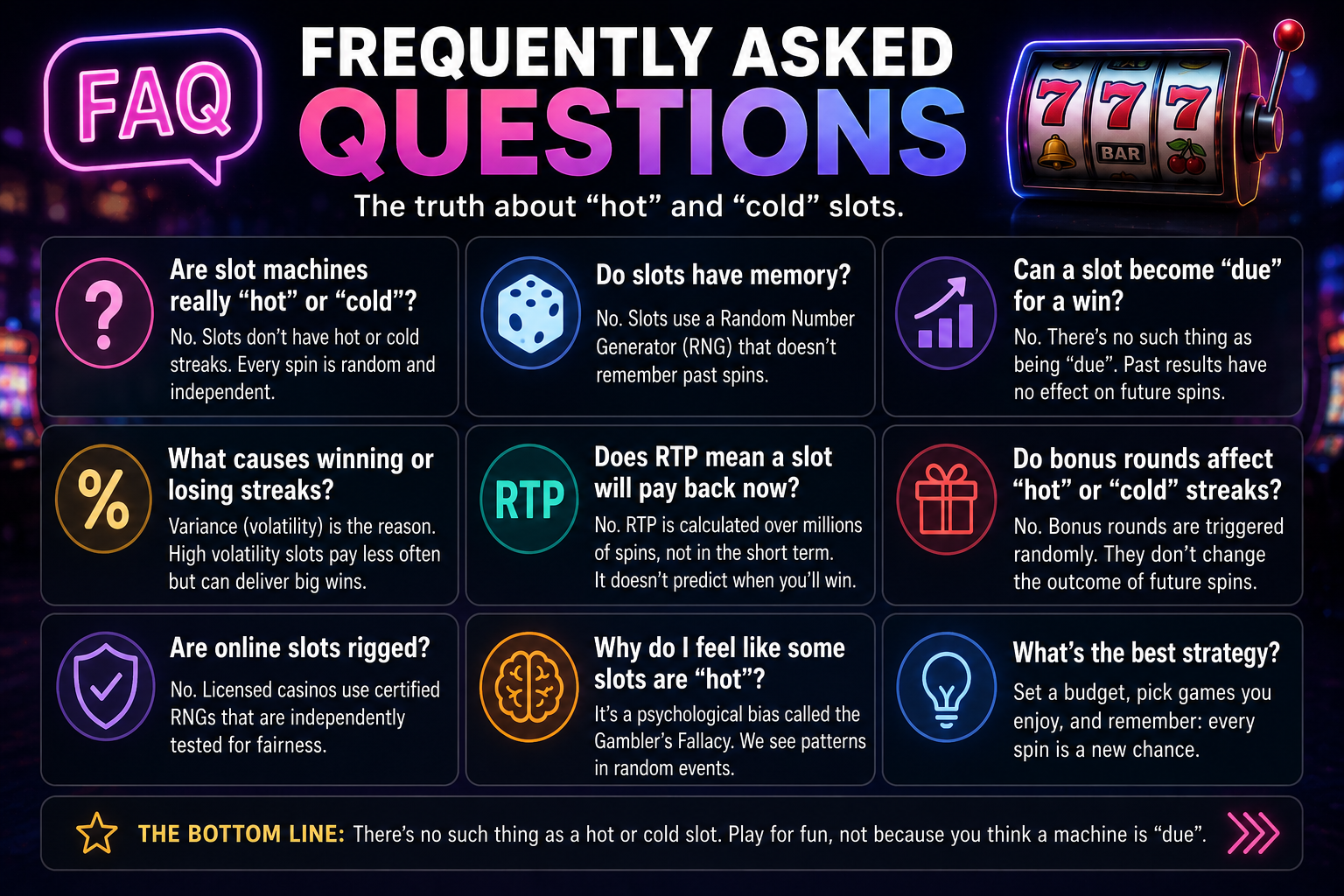
No Shit Frequently Asked Questions
What is RTP in slots? Slot return to player. The percentage of wagered money a slot pays back over millions of spins. 96% RTP means £96 returned per £100 wagered long-term. The casino keeps the rest. It’s not a guarantee for your session – it’s a statistical average over an enormous sample size.
What are the best RTP slots? Mega Joker (99%), Book of 99 (99%), Blood Suckers (98%), White Rabbit Megaways (97.7%), Medusa Megaways (97.63% with bonus buy). Anything above 97% is excellent. Anything above 96% is acceptable. Below 95% and you’re giving the casino a bigger edge than most table games.
What is slot volatility? How dramatic the ride is between wins. Low volatility means frequent small payouts. High volatility means rare large payouts. Same long-term return, completely different short-term experience. Low vol is a salary, high vol is commission-only, especially in online slot machines.
What’s the difference between volatility and variance? Nothing. Same concept, different word. Slot variance explained is the same thing as slot volatility explained in the context of modern slot game mechanics. Some providers use one term, some use the other. They mean identical things in terms of the type of slot.
What is hit frequency in slots? The percentage of spins that produce any payout. Average is 25-27%. A 30% hit frequency means roughly one in three spins returns something – but “something” might be less than your stake. Hit frequency tells you how often you win. RTP tells you how much you win. Volatility tells you how those wins are distributed.
Are low volatility slots better? For bankroll preservation, yes. For excitement, not really. Low volatility slots let you play slot machines longer on the same budget because wins come frequently. But those wins are smaller and you’re unlikely to hit anything life-changing. Whether that’s “better” depends on what you’re playing for.
Can you find a slot’s hit frequency based on the symbols on the reels? Sometimes. Some providers publish it in the game info. Some classic slot machines don’t. Volatility rating is a rough proxy – low volatility generally means higher hit frequency. Sites like SlotCatalog list hit frequencies where available.


